

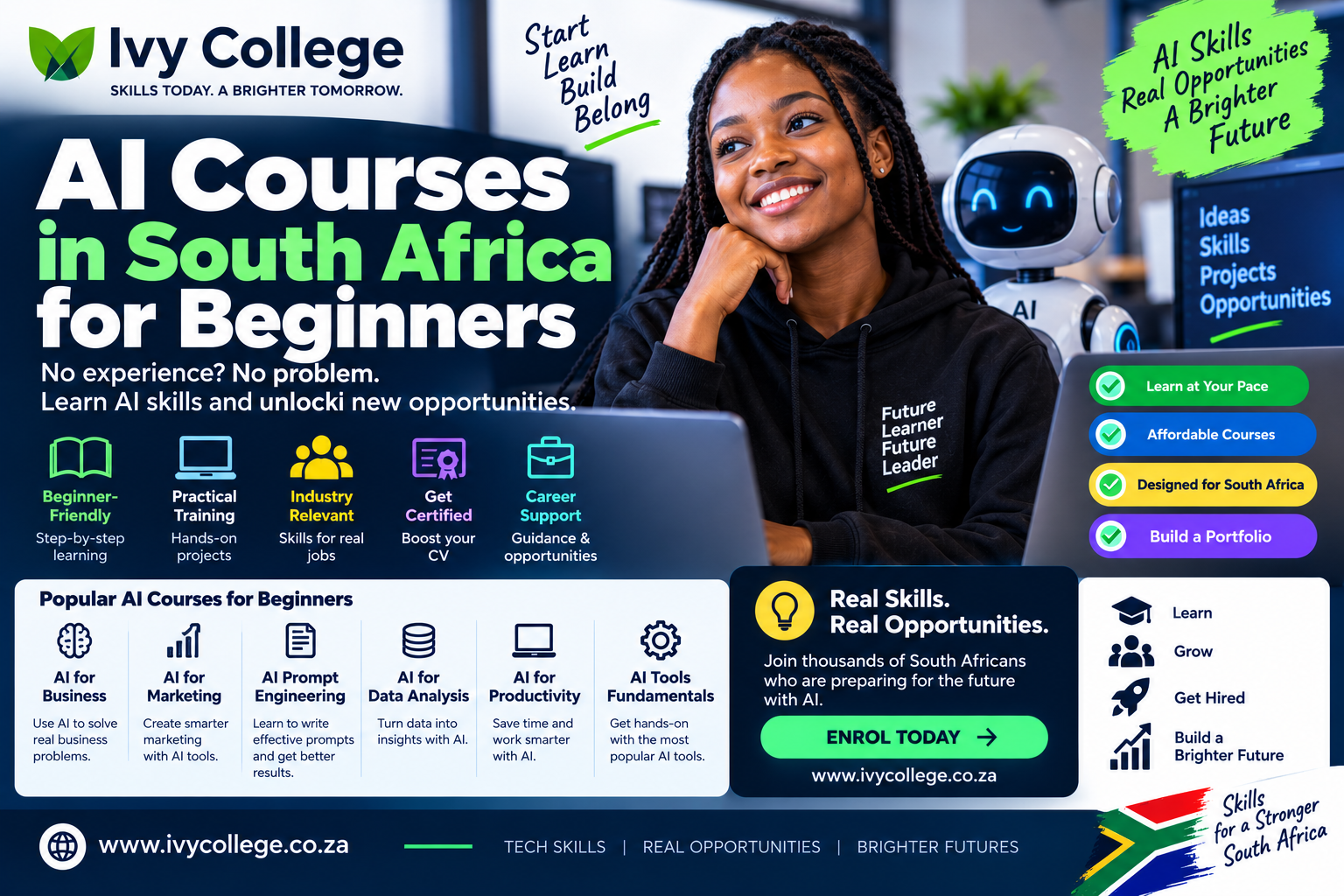
Artificial intelligence is no longer a subject reserved for researchers and large technology companies. South African professionals, business owners and students are using AI to analyse information, automate routine work, improve customer service and build new products.
If you are searching for the best AI courses in South Africa for beginners, the number of options can be confusing. This guide explains the main learning paths, the skills worth prioritising and the questions to ask before enrolling.
An AI course teaches you how computer systems perform tasks that normally require human intelligence, such as understanding language, recognising patterns, making predictions and generating content. Beginner courses may focus on everyday AI use, while technical programmes cover Python, data, machine learning and model deployment.
The right starting point depends on what you want to achieve. A manager who wants to introduce AI into business operations needs a different curriculum from a learner who wants to become an AI engineer.
AI skills are becoming useful in financial services, retail, healthcare, education, logistics, marketing and software development. Microsoft announced an initiative in 2025 intended to provide AI and cybersecurity skilling opportunities to one million South Africans by 2026. That does not mean every learner will become an AI engineer, but it shows why practical AI literacy matters across occupations.
Learning AI can help you:
These programmes introduce generative AI tools, effective prompting, fact-checking and safe workplace use. They are suitable for non-technical learners, office professionals and small-business owners.
Prompt engineering training teaches you to give AI systems clear tasks, context, examples, constraints and output formats. Read Ivy College’s prompt engineering course guide to understand this pathway.
Machine learning is more technical. You learn how algorithms find patterns in data and generate predictions. A useful foundation normally includes Python, statistics, data preparation and model evaluation.
AI engineering combines programming, data, machine learning and deployment. Learners may build applications that use trained models or connect to existing AI services. Explore Ivy College’s AI Engineer courses for a deeper technical pathway.
Role-based programmes apply AI to marketing, finance, human resources, education, healthcare, sales or management. These are most valuable when they use realistic tasks from the profession rather than generic demonstrations.
A strong foundation should include:
Technical learners should also look for Python, SQL, version control and basic statistics. Ivy College’s Python Bootcamp and Data Science courses can support those foundations.
You do not need coding to start with AI literacy, generative AI or role-specific productivity. If your goal is to build machine-learning models or AI applications, you will need programming and mathematics.
Beginners should not wait until they know everything. Start with basic Python and statistics, complete small projects, and add complexity gradually. A course should clearly state its prerequisites so you can choose the right level.
Portfolio projects should solve a clear problem and show how you checked the result. Examples include a customer FAQ assistant grounded in approved documents, a simple sales-data analysis, an email-classification prototype, a responsible marketing-content workflow or a small prediction model.
Document the problem, dataset or source material, process, result, limitations and next improvement. Never publish confidential information or personal data in a portfolio.
Choose an introductory course covering AI concepts, practical prompting, verification and responsible use. Add Python and data skills if you want a technical career.
Entry requirements differ between providers. Some short courses accept beginners without formal technical qualifications, while advanced or accredited programmes may have specific requirements. Confirm directly with the provider.
No responsible provider can guarantee employment. A course can help you develop skills, but employers also consider your portfolio, broader knowledge, experience and communication ability.
Basic AI literacy can be developed relatively quickly. Becoming capable in AI engineering or machine learning requires sustained practice in programming, data, mathematics and project work.
Start with the outcome you want, then select a course that matches your level and includes practical work. If you want to move from beginner concepts into technical AI development, explore Ivy College’s AI Engineer courses or contact Ivy College for guidance.
