

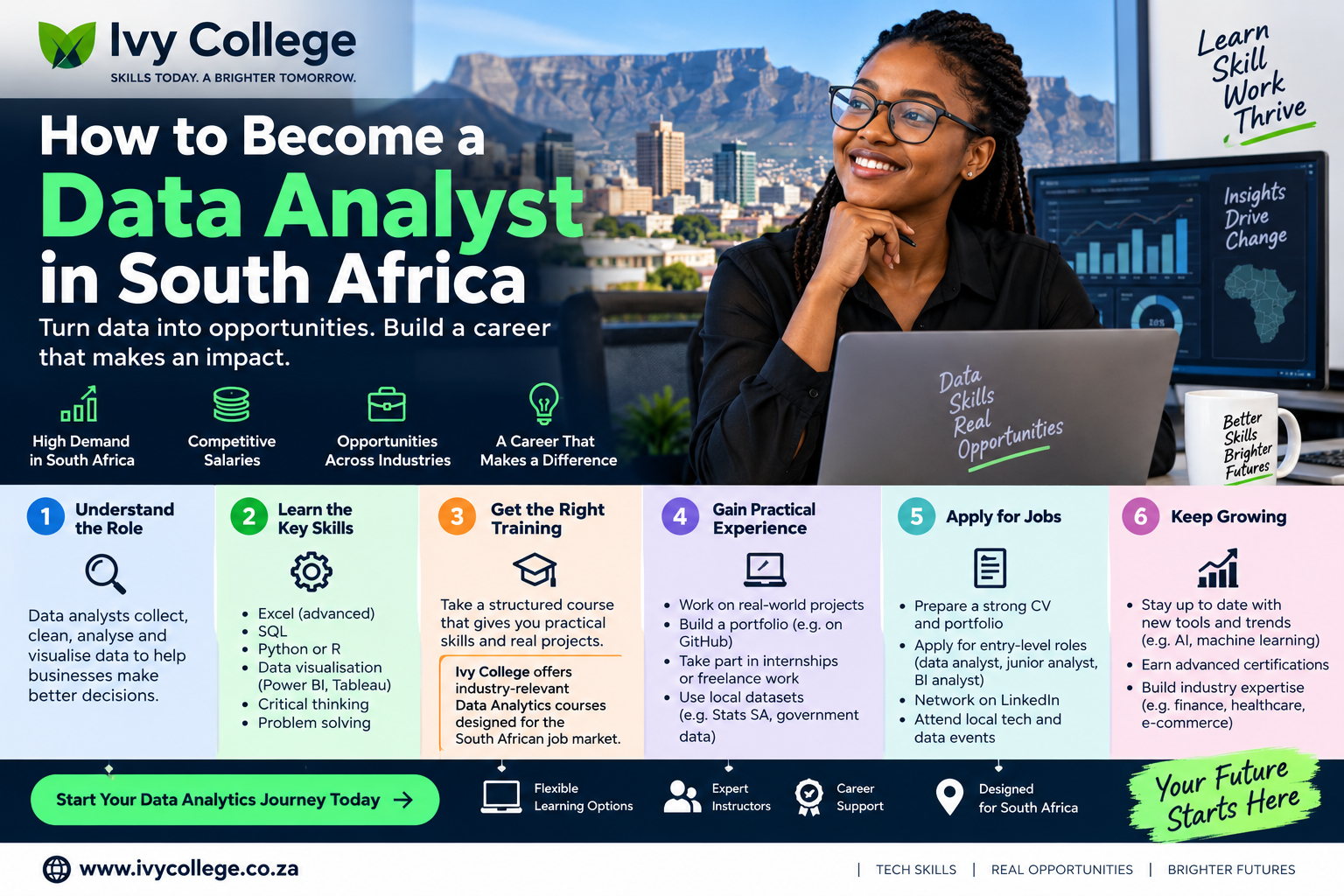
South African organisations generate data through sales, finance, customer service, operations and digital platforms. Data analysts turn that information into reports and recommendations that people can use to make decisions.
If you want to know how to become a data analyst in South Africa, you need more than a list of software tools. You need a structured learning path, evidence of practical ability and the communication skills to explain what the numbers mean.
A data analyst collects, cleans and examines data to answer business questions. The work may include building dashboards, tracking performance, identifying trends and presenting findings to managers or clients.
Typical responsibilities include:
A data analyst commonly focuses on what happened, why it happened and how to communicate the result. A data scientist may build predictive models and use more advanced statistics or machine learning. The roles overlap, and job titles vary.
Data analysis is often the more accessible entry point. You can later expand into data science through Ivy College’s Data Science courses or compare options in the guide to data science courses in South Africa.
Excel remains useful in organisations of every size. Learn formulas, logical functions, lookups, PivotTables, charts and data-cleaning techniques. Practise on untidy files rather than perfect classroom examples.
SQL allows analysts to retrieve and combine information stored in databases. Entry-level learners should understand SELECT, WHERE, ORDER BY, GROUP BY, aggregate functions and JOIN operations.
Do not only memorise syntax. Practise translating a business question—such as which products generated the most revenue in each province—into a query and then checking the result.
A dashboard should help someone make a decision, not simply display as many charts as possible. Learn how to choose appropriate visuals, create useful measures, filter information and explain important changes.
Power BI is a common learning choice because it connects well with Microsoft tools. Microsoft’s PL-300 certification outlines skills for preparing, modelling, visualising and analysing data in Power BI, but certification is optional and should complement practical projects.
Start with averages, medians, percentages, distributions, variation, correlation and sampling. You should understand what a measure means, when it can mislead and whether the data supports your conclusion.
Python helps with larger datasets, repeatable cleaning, automation and more advanced analysis. Beginners can learn variables, conditions, loops and functions before moving to libraries such as pandas and Matplotlib.
If you want structured programming practice, see Ivy College’s Python Bootcamp in Johannesburg.
Tools alone do not make an effective analyst. Employers need people who can clarify an unclear request, understand business definitions and explain limitations honestly.
Practise writing a one-page summary with the question, method, key finding, recommended action and limitations. Your explanation should be understandable to someone who has not seen the dataset.
Create three strong projects rather than many unfinished notebooks. Useful South African portfolio ideas include:
For each project, include the question, data source, cleaning steps, analysis, visualisation, conclusion and limitations. Remove personal or confidential information.
Some employers require a degree, especially for graduate programmes or analytically demanding roles. Others consider candidates with relevant certificates, demonstrable projects and work experience. Read each vacancy carefully rather than assuming one requirement applies everywhere.
A practical data analysis course in South Africa can provide structure and feedback, but you still need independent practice and a portfolio.
Ivy College’s Internship Program may also help learners investigate practical-experience opportunities.
There is no fixed period. It depends on your starting skills, study time and project quality. Use a skills checklist and portfolio evidence rather than relying only on the number of months studied.
Start with Excel, SQL and one visualisation tool. Add statistics and Python as your projects become more advanced.
You can begin without professional analytics experience, but you need evidence of ability. Portfolio projects, internships and analysis completed in another role can provide that evidence.
No. Data analysts interpret and communicate data, while data engineers build and maintain systems that collect, transform and deliver it. Learn more in Ivy College’s guide to Data Engineering courses in South Africa.
Becoming a data analyst requires consistent practice across tools, problem-solving and communication. Explore Ivy College’s Data Analysis course or contact Ivy College to discuss your learning goals.
